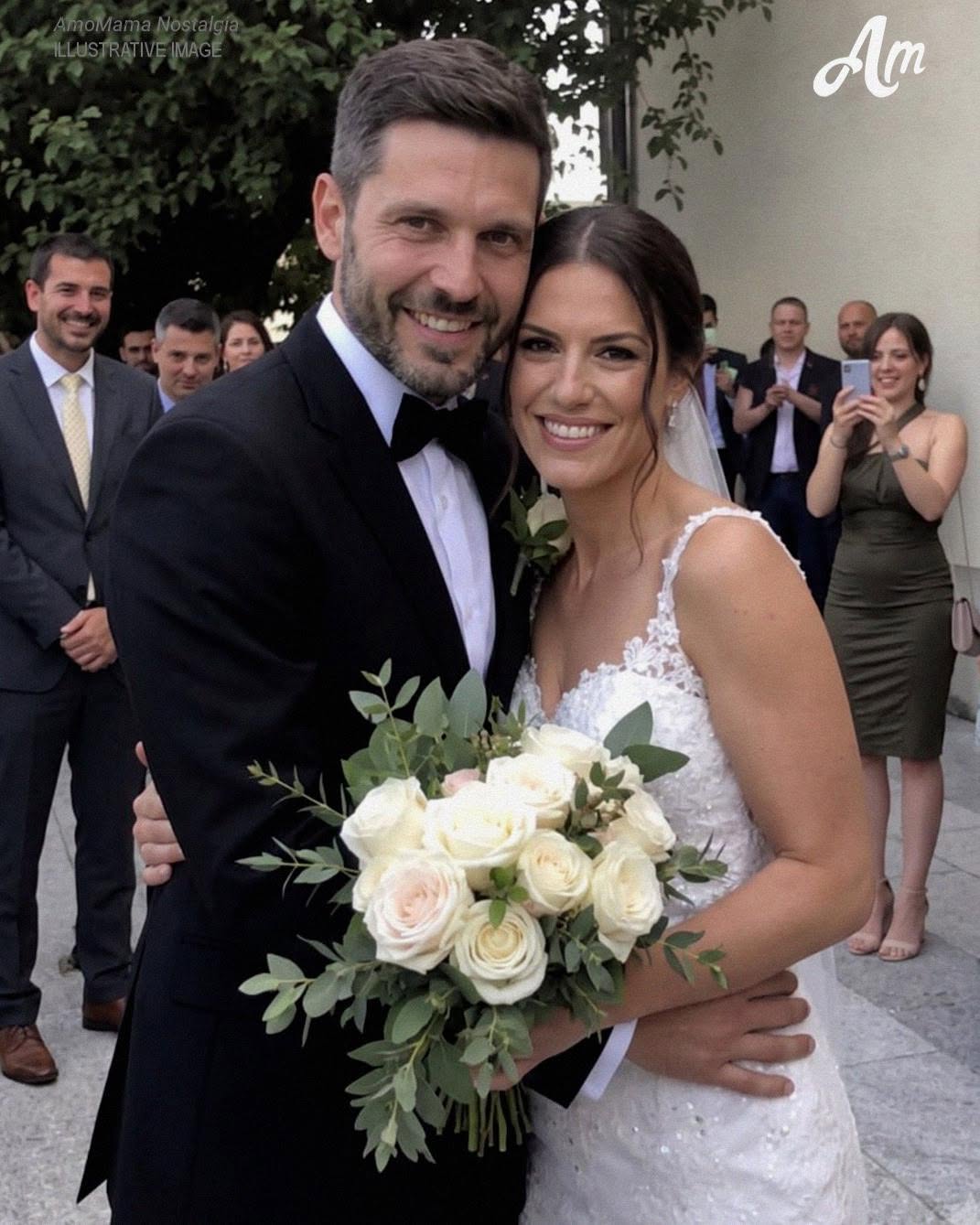
My Fiancé Begged Me Not to Invite His Mother to Our Wedding – But She Showed up Anyway, Dressed in Black, and Whispered, ‘Ask Him What He Did 10 Years Ago’
For four years, I thought I knew every part of Adam except the one involving his mother. He always said she had destroyed his childhood. I believed him completely — until she showed up at our wedding dressed in black and quietly asked me the one question only Adam could answer.
I met Adam at a coffee shop four years ago.
He was sitting at the table next to mine, quietly helping an elderly woman figure out her phone.
I watched him the whole time. When he finally sat back down and caught me looking, he just shrugged and said, “She reminded me of my aunt.”
That was the moment I knew.
“She reminded me of my aunt.”
***
Four years later, standing in front of my mirror in a white dress while my mother fussed with my veil, I thought about that coffee shop and felt a warmth so steady it was almost impossible to imagine anything disturbing it.
I should have paid more attention to the word almost.
There was only one thing about Adam I never fully understood.
His mother.
In four years, he had mentioned her exactly three times, and each time the same thing happened.
I should have paid more attention.
Something behind his eyes closed, the way a door closes when the person on the other side doesn’t want to be found.
“She destroyed my childhood,” he told me once, quietly, with a finality that made it clear the conversation was over. “I haven’t spoken to her in years. I don’t plan to.”
I asked once, maybe six months into our relationship, whether he ever thought he might regret cutting contact.
He stared out the window for so long I assumed he hadn’t heard me. Then he said quietly, “Some doors have to stay closed.”
“She destroyed my childhood.”
I didn’t push after that.
Families are complicated, and everyone carries wounds they’d rather not unwrap in front of someone they love.
When Adam asked me not to invite her to the wedding, I agreed without hesitation.
Some boundaries exist for good reasons, I told myself.
I believed that completely, right up until the moment the church doors opened.
Families are complicated.
***
The music had just begun.
I was at the back of the aisle, bouquet in hand, my father’s arm warm and solid under mine.
Every face in the church had turned toward me, and for one perfect, suspended moment, everything was exactly as I had imagined it would be.
Then a woman walked through the doors behind me.
She was dressed entirely in black, walking with deliberate calm.
She was dressed entirely in black.
I didn’t know who she was yet, but I felt the shift in the room before I understood it.
Adam saw her first.
The color drained from his face.
Not anger, not exactly. Something rawer than anger. Something colder.
Something terrifying.
I didn’t know who she was yet.
She stopped in front of me. Up close, she looked tired.
“Honey, I’m not here to cause a scene,” she told me. “I’m Adam’s mother. My name’s Patsy. He didn’t want me to come, but I had no choice.”
Behind me, I heard Adam’s voice, sharp and controlled.
“Someone needs to ask her to leave.”
“I’m Adam’s mother.”
Patsy didn’t look at him. She kept her eyes on mine.
“Someone should have warned me too.”
My stomach tightened. “What does that mean?”
She leaned slightly closer. “Ask him what he did 10 years ago.”
“Tell me what?” I gasped.
“Ask him what he did 10 years ago.”
She swallowed once. “The truth about the night that destroyed our family.”
The organ fell silent in the middle of a note.
Nobody moved. Not the minister, not the guests, not Adam.
A hundred people held their breath inside a church on what was supposed to be the happiest day of my life.
“The truth about the night that destroyed our family.”
***
My maid of honor, Rachel, slipped forward and suggested that the guests wait while we moved into the small meeting room off the side of the nave.
I turned toward Adam.
His jaw was set. His hands were very still at his sides. He looked like a man preparing for something painful rather than a man with nothing to hide.
“Adam,” I whispered. “Please.”
He looked like a man preparing for something painful.
He looked at me for a long moment. Then he nodded once and walked ahead of us into the room.
***
The three of us sat around a small table clearly used for church committee meetings.
Patsy folded her hands on the table and looked at her son.
Adam stared at the wall.
“What happened ten years ago?” I asked.
“What happened ten years ago?”
Neither of them spoke.
The silence lasted long enough that I understood, without anyone telling me, that whatever this was had been sealed for a very long time.
Adam rubbed both hands slowly across his face. When he looked up again, he looked older. Not just tired. Older.
Then he said, barely above a whisper: “I killed someone.”
The room went completely still.
“I killed someone.”
He told it slowly, in the flat, careful voice of someone who has rehearsed a story so many times it has worn smooth.
I listened without interrupting.
***
He was 22 when it happened. His younger cousin, Danny, had been visiting for the summer, the last summer before Danny left for college out of state.
On their last night together, Danny begged to borrow Patsy’s pickup truck for a drive. One of those restless teenage nights where being inside feels impossible.
He was 22 when it happened.
Adam agreed and he drove.
Danny reached over and turned the radio up, singing along to a song Adam says he still can’t listen to today.
On a two-lane road outside of town, another vehicle crossed the center line.
The crash was catastrophic.
Adam survived. Danny didn’t.
The crash was catastrophic.
The man I’d been about to marry suddenly looked 10 years younger.
***
“I was driving,” Adam said. “It was my decision to take the truck. Danny was 17 years old and I was supposed to be the responsible one.”
He hadn’t looked at me or at his mother since he started speaking. His eyes were fixed somewhere past the narrow window.
“After the funeral, I couldn’t be around anyone from that night. Everything my mother said felt like an accusation.”
“I couldn’t be around anyone from that night.”
Patsy lowered her eyes.
“I know why you say I destroyed your childhood,” she said. “I was too strict with you. After your father left, I convinced myself that protecting you meant controlling everything.”
Adam didn’t argue.
“I hated you for that long before the accident,” he admitted.
“I know why you say I destroyed your childhood.”
Patsy nodded slowly. “And after Danny died, every time I tried to comfort you, you heard blame instead of love. We were already hurting by then. The accident only finished what it had started.”
“Eventually I told her I needed her to stop trying to talk to me about it. And then I just stopped coming home.” Adam pressed his hands flat on the table. “I didn’t invite her today because I didn’t want you to find out, Claire.”
I looked at Patsy. Her expression was not the expression of a woman who had just heard the complete story.
“Is that what you believe happened?” she asked softly.
“I didn’t want you to find out.”
Adam looked at her for the first time. “Yeah.”
“No, it isn’t.”
She reached into her bag and placed a manila envelope on the table.
She didn’t open it immediately.
“Four months ago I received a call from an insurance investigator,” she finally said. “The case had been reviewed. New evidence had surfaced.”
She didn’t open it immediately.
***
Adam didn’t move.
“A truck driver was behind you that night. He witnessed everything, but he never came forward. He was afraid of getting involved.” She paused. “He came forward this year. He had dashboard camera footage from that night.”
She opened the envelope and slid a document across the table.
“He was afraid of getting involved.”
“I tried to reach you the moment I found out,” Patsy added. “Letters to your apartment. Phone calls to every number I still had. I finally hired someone to help locate you, but by the time I had a current address, the letters were coming back unopened.” She looked at her hands. “When I found out about the wedding through your father’s cousin, I understood it might be the only chance I would ever have.”
Adam didn’t reach for the document. He was still looking at her.
“I understood it might be the only chance.”
“The other driver was intoxicated,” Patsy said. “Nearly three times the legal limit. He crossed fully into your lane approximately four seconds before impact. The investigators concluded you had no possible reaction time. There was nothing you could have done.”
Adam picked up the document. He read it once. Then went back to the beginning and read it again, more slowly.
His hands had started shaking somewhere in the middle of the first page.
“There was nothing you could have done.”
He stopped on the witness statement. Read it a third time, very carefully, as though checking whether the words would change if he looked at them long enough.
Then he put the document down.
“It wasn’t me.”
“No,” Patsy whispered. “It was never you.”
The sound Adam made then is not something I can fully describe.
“It was never you.”
It wasn’t crying exactly, or not only that. It was the sound of something that has been held rigid for 10 years finally, without warning, releasing all at once.
I moved my chair beside his and took his hand, and he held it.
We sat in that room for a long time.
Outside, our guests waited with a patience I have thought about many times since. Nobody left.
Outside, our guests waited.
***
When Rachel slipped in quietly to check on us, I shook my head once and she nodded and pulled the door closed again.
There were no dramatic speeches in that small room. No moment where everything was resolved and made clean.
Patsy and Adam talked the way people talk when they are finding their way back across a very long distance.
At some point Adam said: “I’m sorry I stopped letting you try.”
Patsy said: “I’m sorry I let the silence go on as long as I did.”
“I’m sorry I stopped letting you try.”
Neither sentence covered everything. But they were true, and they were a beginning.
I was the one who finally asked: “Do you still want to get married today?”
Adam looked at me, and there was something in his face I hadn’t seen before.
Not the careful steadiness I had loved for four years; the composure of a man keeping something locked down. Something lighter than that.
Something that looked, genuinely and for the first time, like actual peace.
“Do you still want to get married today?”
“Yes,” he said. “If you’ll still have me.”
“I’ll still have you.”
He turned to his mother. Something passed between them that I didn’t need to fully understand to recognize.
“Will you stay, Mom?”
Patsy smiled, just slightly. “I didn’t get dressed and drive two hours to leave before the cake.”
We walked back into the church.
“I’ll still have you.”
***
I don’t know what our guests had been expecting, but the quiet that fell when we appeared had a different quality than before. This one felt like held breath rather than held alarm.
Adam stood differently than he had all morning.
His shoulders had finally relaxed. His jaw was unclenched. He looked like a man who had set something down after carrying it so long.
Patsy took a seat in the back pew.
He looked like a man who had set something down.
The music started again.
The ceremony was simple and slightly imperfect and completely ours.
When the minister pronounced us married, I heard from somewhere near the back of the church a sound that might have been a small laugh through tears.
***
Several weeks later, Adam and I drove out to the cemetery on a quiet Saturday morning.
It was the first time he had visited Danny’s grave since the funeral.
It was the first time he had visited Danny’s grave.
He carried sunflowers, which he said had been Danny’s favorite.
That detail, so specific and ordinary, made me understand for the first time how fully a person can love someone they’ve spent 10 years trying not to think about.
Patsy was already there when we arrived, standing a few feet from the headstone with a bunch of roses.
The three of us stood together for a while without talking much.
He carried sunflowers.
When we turned to leave, Adam reached over and took his mother’s hand.
She squeezed it once and didn’t let go until they reached the car.
I thought my wedding day would expose the darkest secret my fiancé had ever kept from me.
Instead, it became the day he finally stopped carrying a guilt that had never belonged to him.
It became the day he finally stopped carrying guilt.